On this page 11 sections
ⓘ
We re-read the listed sources on this date. This is not attorney review, and it is not legal advice.
General information, not legal advice. Statutes and rules change; the official sources are linked below.
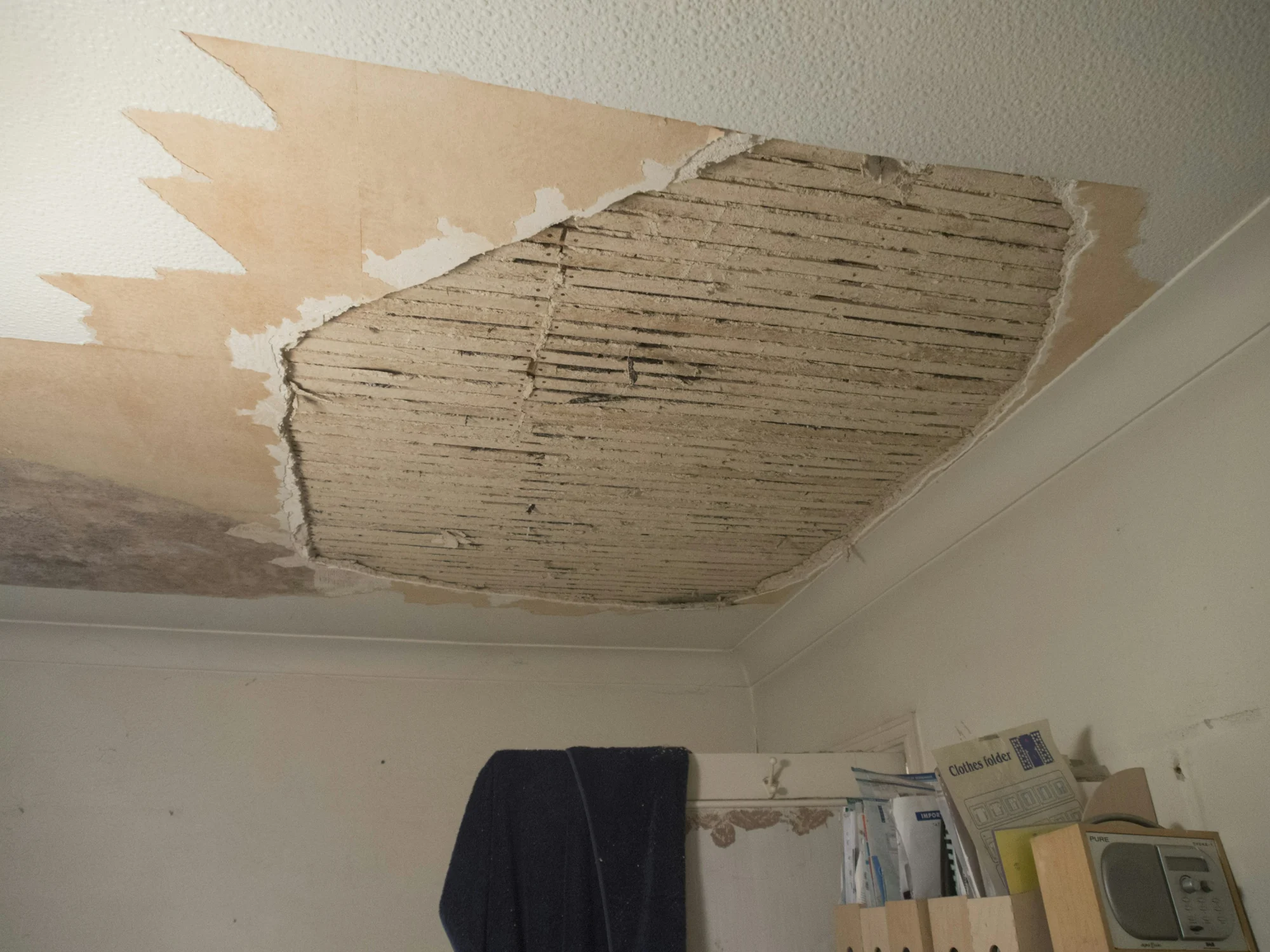
When water comes through your ceiling from the unit above, Florida law splits the repair bill by what was damaged, then asks why it happened. The association rebuilds what its policy must insure, as a common expense that includes the deductible. Each owner covers their own finishes, fixtures, appliances and belongings. The owner upstairs pays the uninsured cost only when the leak came from intentional conduct, negligence or a breach of the declaration or rules. The rules are in section 718.111(11), Florida Statutes.
That is the default. Your declaration, a vote under (11)(k) and the facts of the leak can move it. This guide covers what the statute says as of October 2026, then the first 24 hours and a checklist for owners and for managers.
Who insures what, side by side
| Damaged item | Who insures it under the default rules | Who pays the uninsured part |
|---|---|---|
| Drywall, structure and original installations that the association must insure | Association policy | Common expense, including the deductible, unless the (11)(j) negligence exception applies |
| Floor, wall and ceiling coverings inside the unit (tile, carpet, paint, wallpaper) | Unit owner | Unit owner |
| Electrical fixtures, appliances, water heaters, water filters | Unit owner | Unit owner |
| Built-in cabinets, countertops, window treatments | Unit owner | Unit owner |
| Furniture, clothing and other personal property | Unit owner | Unit owner |
| Non-standard upgrades installed by an owner or the developer that benefit only one unit | Any policy that specifically covers them | The association need not pay under (11)(n) |
| Any of the above, if the upstairs household caused it through intentional conduct, negligence or a rules breach | Whichever policy applies | The responsible unit owner, for costs insurance does not pay |
What the association's policy must cover
What the law says
Adequate insurance, whatever the declaration says. "Every condominium association shall have adequate property insurance as determined under this paragraph," regardless of any requirement in the declaration (§718.111(11)(a)).
Primary coverage. The association's property policy "must provide primary coverage for" the condominium property "as originally installed or replacement of like kind and quality," and for "All alterations or additions made to the condominium property or association property" under the declaration (§718.111(11)(f)).
What it excludes. "The coverage must exclude all personal property within the unit or limited common elements," and "floor, wall, and ceiling coverings, electrical fixtures, appliances, water heaters, water filters, built-in cabinets and countertops, and window treatments," including curtains, drapes and blinds, "or replacements of any of the foregoing which are located within the boundaries of the unit and serve only such unit" (§718.111(11)(f)3). Those items are the unit owner's to insure.
Deductibles. "Policies may include deductibles as determined by the board," consistent with industry standards for similar communities, and set at a board meeting (§718.111(11)(c)).
Recommended operating practice
Read the exclusion list slowly. In a typical ceiling leak, the drywall behind the paint may be the association's, while the paint, the light fixture and the wet sofa are the owner's. That split is why two claims, the association's and the owner's, often run on the same leak.
Who does the repair work
What the law says
"All reconstruction work after a property loss must be undertaken by the association except as otherwise authorized in this section." An owner "may undertake reconstruction work on portions of the unit with the prior written consent of the board of administration." Unit owners "are responsible for the cost of reconstruction of any portions of the condominium property" that they are required to insure, and that cost "is chargeable to the unit owner and enforceable as an assessment" (§718.111(11)(g)).
Recommended operating practice
Owners often want to hire their own contractor the next morning. Get the board's written consent first, and keep a copy with the claim file.
How reconstruction costs are allocated under (11)(j)
What the law says
Property the association must insure under (11)(f) that "is damaged by an insurable event shall be reconstructed, repaired, or replaced as necessary by the association as a common expense." And: "All property insurance deductibles and other damages in excess of property insurance coverage under the property insurance policies maintained by the association are a common expense of the condominium, except that" (§718.111(11)(j)):
- "A unit owner is responsible for the costs of repair or replacement of any portion of the condominium property not paid by insurance proceeds if such damage is caused by intentional conduct, negligence, or failure to comply with the terms of the declaration or the rules of the association by a unit owner, the members of his or her family, unit occupants, tenants, guests, or invitees, without compromise of the subrogation rights of the insurer."
- The same responsibility extends to "personal property of other unit owners or the association," and other property the unit owners must insure.
- If the association collects the cost from the owner and is later reimbursed by insurance, "the association shall reimburse the unit owner."
- "The association is not obligated to pay for reconstruction or repairs of property losses as a common expense if the property losses were known or should have been known to a unit owner and were not reported to the association until after the insurance claim of the association for that property was settled or resolved with finality, or denied because it was untimely filed."
Opting out. An association may, "upon the approval of a majority of the total voting interests," opt out of paragraph (j) and allocate repair costs as the declaration provides (§718.111(11)(k)).
Upgrades. The association does not have to pay to rebuild improvements an owner or the developer installed that benefit only one unit and are not standard (§718.111(11)(n)).
Recommended operating practice
"Negligence" carries the dispute. A supply line that bursts without warning reads differently from a washing machine left running with a known bad hose, or a renovation done against the rules. The statute does not decide which side a given leak falls on. Evidence does: plumber's reports, photos, dates, and prior complaints or violation notices. Collect it on day one.
Common elements, the unit and the pipes in the wall
What the law says
"Maintenance of the common elements is the responsibility of the association, except for any maintenance responsibility for limited common elements assigned to the unit owner by the declaration" (§718.113(1)).
Common elements include "Easements through units for conduits, ducts, plumbing, wiring, and other facilities for the furnishing of utility services to units and the common elements," and installations that provide utilities or other services to more than one unit or to the common elements (§718.108(1)).
The association also "has the irrevocable right of access to each unit during reasonable hours," when needed for maintenance or repair of the common elements "or as necessary to prevent damage to the common elements or to a unit" (§718.111(5)(a)).
Recommended operating practice
A riser that serves a stack of units is a different case from the braided line under one owner's sink. Where the line sat, what it served and who the declaration says maintains it decide the maintenance question. The insurance split under (11)(f) and (11)(j) is a separate question, so answer both. The right of access matters at 10 PM: if the upstairs owner is away, the association can get in to stop the water.
What the unit owner's policy must include
What the law says
A condominium unit owner policy must conform to section 627.714 (§718.111(11)(g)). For policies issued or renewed on or after July 1, 2010, the unit owner's residential property policy "must include at least $2,000 in property loss assessment coverage" for assessments from the same direct loss, with "a deductible of no more than $250 per direct property loss." The owner's coverage is excess over the amount recoverable under any other policy covering the same property (§627.714).
Recommended operating practice
Insurers sell this as a condo or HO-6 policy. One Florida carrier describes its version as "also known as an HO6 policy," with coverage for the unit's built-in features, personal property, loss assessments and liability (Security First Insurance). Policies differ. Ask your agent how your limits line up with the (11)(f)3 list above.
Mold and slow leaks
The fastest way to turn a covered leak into a dispute is to let it sit. The EPA's guidance on mold remediation lays out strategies "to respond to water damage within 24-48 hours," including drying carpet and backing in that window (EPA, Mold Remediation guide, Chapter 4). A slow leak that an owner noticed and ignored can also run into the late-reporting rule in (11)(j)4. Report stains and drips when you see them.
The first 24 hours
Florida's Department of Financial Services tells policyholders to report the claim to the insurer right away, "Make emergency repairs to protect your property from further damage," and "Take photos before and after the repairs and keep receipts" (DFS, What to Expect After Filing a Homeowners Claim). Notice of an initial property insurance claim must be given "within 1 year after the date of loss" (§627.70132). A Becker & Poliakoff article for managers puts the association's side plainly: "regardless of who caused the water leak, the condominium association has a duty to protect the condominium," and it advises hiring a plumber to stop the leak and notifying the carriers and counsel (Becker, Dealing with a Water Leak).
ChecklistFor the unit owner below (or above)
ChecklistFor managers and boards
Disputes between neighbors outside the association's framework, such as a claim for a damaged rug against the owner upstairs, are a question for each owner's insurer and a Florida attorney.
Where TowerLine AI fits
A leak does not wait for office hours. TowerLine AI's AI concierge answers resident calls around the clock in the caller's language. Listen to a recorded flood call: at 9:47 PM a resident reports water coming through the bathroom ceiling in unit 1407. The AI concierge gives the safety instruction first, opens an urgent request and pages the on-call tech. The time of the call, the unit and what the resident described go on the record, which is the timeline a manager and an insurer will ask for later. Who pays, and whether to charge an owner back, stays with your board, your insurer and your attorney.
For the escalation policy behind that page, read the after-hours maintenance playbook. For other Florida association rules, see the Florida Hub.
Frequently asked questions
Who pays when water from an upstairs condo damages my ceiling in Florida?
Under section 718.111(11)(j), damage to property the association must insure is repaired by the association as a common expense, including the deductible. Your own ceiling paint, flooring, fixtures, appliances and belongings are yours to insure. The upstairs owner pays uninsured costs if the leak came from intentional conduct, negligence or a breach of the declaration or rules.
Does the association's insurance deductible get charged to the unit owner?
Not by default. Section 718.111(11)(j) makes property insurance deductibles and damage above the policy limits a common expense. The exceptions are damage caused by an owner's household, tenants or guests through intentional conduct, negligence or a rules breach, and a loss the owner knew about but reported too late. A recorded opt-out under (11)(k) can change the allocation.
Are the pipes inside my walls part of my unit or a common element?
It depends on your declaration. Section 718.108 says common elements include easements through units for plumbing and other utility facilities, and installations that serve more than one unit. A supply line that serves only your unit may be assigned to you. Read the unit boundary and maintenance sections of your declaration, then ask the manager or an attorney.
What does an HO-6 policy have to include in Florida?
Section 627.714 requires a unit owner's residential property policy issued or renewed on or after July 1, 2010 to include at least $2,000 of loss assessment coverage, with a deductible of no more than $250 per direct property loss. The owner's policy is excess over any other policy covering the same property. Your agent can explain the rest of your coverage.
How long do I have to file an insurance claim for water damage?
Section 627.70132 requires notice of an initial or reopened property insurance claim within 1 year after the date of loss, and a supplemental claim within 18 months. Report sooner. Under section 718.111(11)(j), the association need not cover a loss you knew about but did not report until after its own claim was settled or denied as untimely.
Sources
- Section 718.111, Florida Statutes (2026): insurance (11)(a), (c), (f), (g), (j), (k), (n); right of access (5)(a) (retrieved October 27, 2026; 2025 text also checked at flsenate.gov)
- Section 718.113, Florida Statutes (2026): maintenance of common elements (retrieved October 27, 2026)
- Section 718.108, Florida Statutes (2026): common elements (retrieved October 27, 2026)
- Section 627.714, Florida Statutes (2026): residential condominium unit owner coverage (retrieved October 27, 2026)
- Section 627.70132, Florida Statutes (2026): notice of property insurance claim (retrieved October 27, 2026)
- Florida Department of Financial Services, What to Expect After Filing a Homeowners Claim (June 2025) (retrieved October 27, 2026)
- Becker & Poliakoff, Dealing with a Water Leak, FCAP Managers Report (July 2, 2026) (retrieved October 27, 2026)
- U.S. EPA, Mold Remediation in Schools and Commercial Buildings Guide, Chapter 4 (retrieved October 27, 2026)
- Security First Insurance, Condominium insurance (retrieved October 27, 2026)
This guide is general information, not legal advice. Who pays for a leak depends on your declaration, any opt-out your association recorded, your policies and the facts of the loss. Read your declaration, call your insurer, and confirm the answer with a Florida community association attorney before you rely on this summary.