
On this page 12 sections
ⓘ
We re-read the listed sources on this date. This is not attorney review, and it is not legal advice.
General information, not legal advice. Statutes and rules change; the official sources are linked below.
Since January 1, 2026, a Florida association that manages a condominium with 25 or more units and no timeshare units must post specified official records on a website or mobile app. The records sit in a protected section that only unit owners and association employees can open, and each new record goes online within 30 days after the association receives or creates it. The rule is section 718.111(12)(g), Florida Statutes. Until 2026 it applied only at 150 units.
For many small and mid-size buildings, that was the first time anyone had to answer three questions: where do our records live, who can see them, and who puts them there on time. This guide follows the statute in the order a manager meets it.
The bills behind the 25-unit rule
- HB 1021 (2024) lowered the threshold from 150 units to 25, effective January 1, 2026, and added criminal penalties for the worst records conduct (ch. 2024-244; HB 1021 final bill analysis).
- HB 913 (2025) made recordings of meetings held by video conference part of the official records, added them to the posting list, and requires a director or officer to sign an affidavit acknowledging receipt of the completed structural integrity reserve study (HB 913 final bill analysis).
- 2026 session: no substantive change to §718.111(12). HB 657 died in the Senate Rules Committee. The 2026 statutes carry the reviser's technical corrections (ch. 2026-14) and a reenactment of §718.111(1)(d) on directors' duties (ch. 2026-168). We re-read subsection (12) in the 2026 statute text on October 4, 2026.
The rest of what HB 1021 and HB 913 changed, from director education to video conference meetings, is collected in What changed for Florida condo associations in 2024 and 2025.
Each requirement and what to put in place
| Requirement | What the law says | Source | What to put in place |
|---|---|---|---|
| Coverage | 25 or more units, no timeshare units, from January 1, 2026 | §718.111(12)(g)1 | Confirm the unit count with counsel if the association runs more than one condominium |
| Owner-only area | Inaccessible to the public; open to unit owners and association employees | §718.111(12)(g)1 | Separate owner logins from renter and resident access |
| Login on request | Username and password after an owner's written request | §718.111(12)(g)1 | Log the request date and the date access was granted |
| Posting window | Within 30 days after the association receives or creates the record | §718.111(12)(g)1 | A received date, a due date and a named person on every record |
| Owner meetings | Notice and agenda 14 days before; voting documents 7 days before; on the front page or a linked Notices page | §718.111(12)(g)2 | Calendar both dates the day the meeting is set |
| Redaction | Protected information redacted before posting; protected records kept off the site | §718.111(12)(g)3 and (12)(c)5 | Two people review every upload |
| Records requests | 10 working days after a written request; checklist of what was provided | §718.111(12)(c) | Date-stamp requests and track the working-day count |
Who does the 25-unit rule cover?
What the law says
"An association managing a condominium with 25 or more units which does not contain timeshare units shall post digital copies of the documents specified" on its website or through a downloadable app (§718.111(12)(g)1). The site can be one the association owns and operates, or one run by a third-party provider the association has the right to use. DBPR lists January 1, 2026 as the deadline for associations with 25 or more units (DBPR condominium FAQs).
Recommended operating practice
- Below 25 units, a website is optional. Owners in smaller associations still have the right to inspect records on written request, and a posted library usually means fewer requests.
- Associations that run more than one condominium should ask counsel how the unit count applies to their structure.
The protected owner area
What the law says
The website or app must contain a "protected electronic location that is inaccessible to the general public and accessible only to unit owners and employees of the association." On a unit owner's written request, the association must provide a username and password for the protected sections (§718.111(12)(g)1).
Recommended operating practice
- Owners and residents are different audiences. A renter in unit 1402 needs the pool hours and the move-out rules. The owner of unit 1402 is entitled to the minutes and the budget. If every resident gets the same login, you have a permissions problem.
- Log login requests. Record when the written request arrived and when credentials went out. If an owner later says they were locked out, that log is your answer.
The 18 categories to post
Subparagraph 2 lists what goes online. In plain terms, with the person who usually produces each item:
| Record | Notes | Usually produced by |
|---|---|---|
| Declaration of condominium and amendments | As recorded | Counsel |
| Bylaws and amendments | As recorded | Counsel |
| Articles of incorporation and amendments | As filed with the Department of State | Counsel |
| Rules of the association | Current version | Board and manager |
| Approved board meeting minutes | Preceding 12 months | Secretary or manager |
| Video recordings, or links, of meetings held by video conference | Preceding 12 months | Manager |
| List of executory contracts, and bid summaries | Bids over $500 summarized and kept up for 1 year | Manager |
| Annual budget and any proposed budget | For the annual meeting | Manager and treasurer |
| Financial report and monthly statements considered at a meeting | Report type under §718.111(13) | CPA and manager |
| Director certifications | Under s. 718.112(2)(d) | Each director |
| Contracts or transactions with interested directors or officers | Manager | |
| Conflict-of-interest documents | Manager | |
| Notice and agenda of each unit owner meeting | 14 days before | Manager |
| Notice, agenda and documents for each board meeting | On the board-notice timeline | Manager |
| Inspection reports | Milestone and other structural or life-safety inspections | Engineer or architect |
| Most recent structural integrity reserve study | See the SIRS and milestone guide | Reserve professional |
| Building permits for ongoing or planned construction | Contractor and manager | |
| Affidavits required by Chapter 718 | Directors and officers |
Source: §718.111(12)(g)2. DBPR summarizes the same set in its condominium FAQs.
Posting deadlines
What the law says
"Unless a shorter period is otherwise required, a document must be made available on the association's website or made available for download through an application on a mobile device within 30 days after the association receives or creates an official record" (§718.111(12)(g)1).
- Owner meeting notice and agenda: posted no later than 14 days before the meeting.
- Documents to be considered and voted on by the owners: at least 7 days before.
- Where: in plain view on the front page, or on a separate page labeled "Notices" that is conspicuously visible and linked from the front page.
- Board meetings: notice posted conspicuously on the property at least 48 continuous hours before, and 14 days' written notice when a nonemergency special assessment or a rule amendment on unit use will be considered (§718.112(2)(c)).
Recommended operating practice
A worked calendar
Take a 62-unit building whose board meets on Tuesday, October 13.
| Event | Date | Online by |
|---|---|---|
| Board approves the September minutes | Oct 13 | Nov 12 (30 days) |
| Engineer delivers the balcony inspection report | Oct 20 | Nov 19 (30 days) |
| Annual meeting set for Nov 24 | Notice mailed Nov 3 | Notice and agenda by Nov 10 (14 days before) |
| Proposed bylaw amendment the owners will vote on | Nov 17 (7 days before) | |
| Budget workshop held over video conference | Dec 8 | Recording or link by Jan 7 (30 days) |
Election ballots and candidate information follow their own delivery deadlines under §718.112(2)(d); posting them online does not replace the notice sent to owners.
Each date is easy to calculate. Deadlines slip when the minutes sit in the secretary's inbox and the engineer emails the manager's personal address, so every record needs a received date, a due date and a name next to it.
What must never be posted
What the law says
Protected records include privileged material and work product, information obtained in approving a lease or sale, personnel records (disciplinary, payroll, health and insurance), medical records of unit owners, Social Security, driver license and credit card numbers, email addresses, telephone numbers, emergency contacts and addresses other than those used for notices, electronic security measures and passwords, association software, and certain acknowledgments under s. 718.121(4)(c) (§718.111(12)(c)5).
When a required document contains protected information, "the association shall ensure the information is redacted before posting the documents." The association and its agent are not liable for disclosing protected information "unless such disclosure was made with a knowing or intentional disregard of the protected or restricted nature of such information" (§718.111(12)(g)3).
Recommended operating practice
Redaction misses tend to come from the same four places:
- Owner rosters exported with phone numbers and personal email addresses.
- Contract packets that include a vendor employee's background check or a gate system's admin credentials.
- Incident reports and insurance files that mention a resident's medical condition.
- Ledger detail attached to a monthly statement that shows payroll by employee.
The fix is a procedure: nothing is published until a second person reviews it, and the review is logged.
Records requests still run on a 10-day clock
What the law says
A website does not end an owner's right to inspect. Records must be available within 10 working days after a written request, within 45 miles of the condominium or in the same county (§718.111(12)(c)).
- Missing the window creates a rebuttable presumption of willful failure.
- Minimum damages for a willful failure: $50 per calendar day for up to 10 days, starting on the 11th working day.
- With the records, the association provides a checklist of everything made available and names any record that was not.
- Owners may copy with a smartphone, tablet or portable scanner at no charge.
- Retention: the developer's plans, permits and warranties, the declaration, bylaws, articles, rules and minutes permanently; bids at least 1 year; most other records at least 7 years (§718.111(12)(b)).
Section 718.111(12)(c) also carries criminal penalties: a director, board member or community association manager who willfully and knowingly or intentionally violates the inspection rules commits a second-degree misdemeanor and must be removed from office, and refusing to release records to avoid detection of a crime is a third-degree felony (§718.111(12)(c)). HB 1021 first added these penalties in 2024 (HB 1021 final bill analysis). A failure to post "is not in and of itself sufficient to invalidate any action or decision of the association's board or its committees" (§718.111(12)(g)4), but owners who cannot find a record send a written request, and that request has its own clock.
The full request workflow, from intake to the checklist, is in Florida condo and HOA official records requests.
Setup checklist
ChecklistFor boards and managers
Managing HOAs too? The Chapter 720 rules are similar but not identical: Florida HOA website requirements under Chapter 720. For how these rules look as one workflow in a condominium, see Condominiums & high-rises. The document folders, posting dates and board-only records are shown on the Board Portal page.
Where TowerLine AI fits in a records program
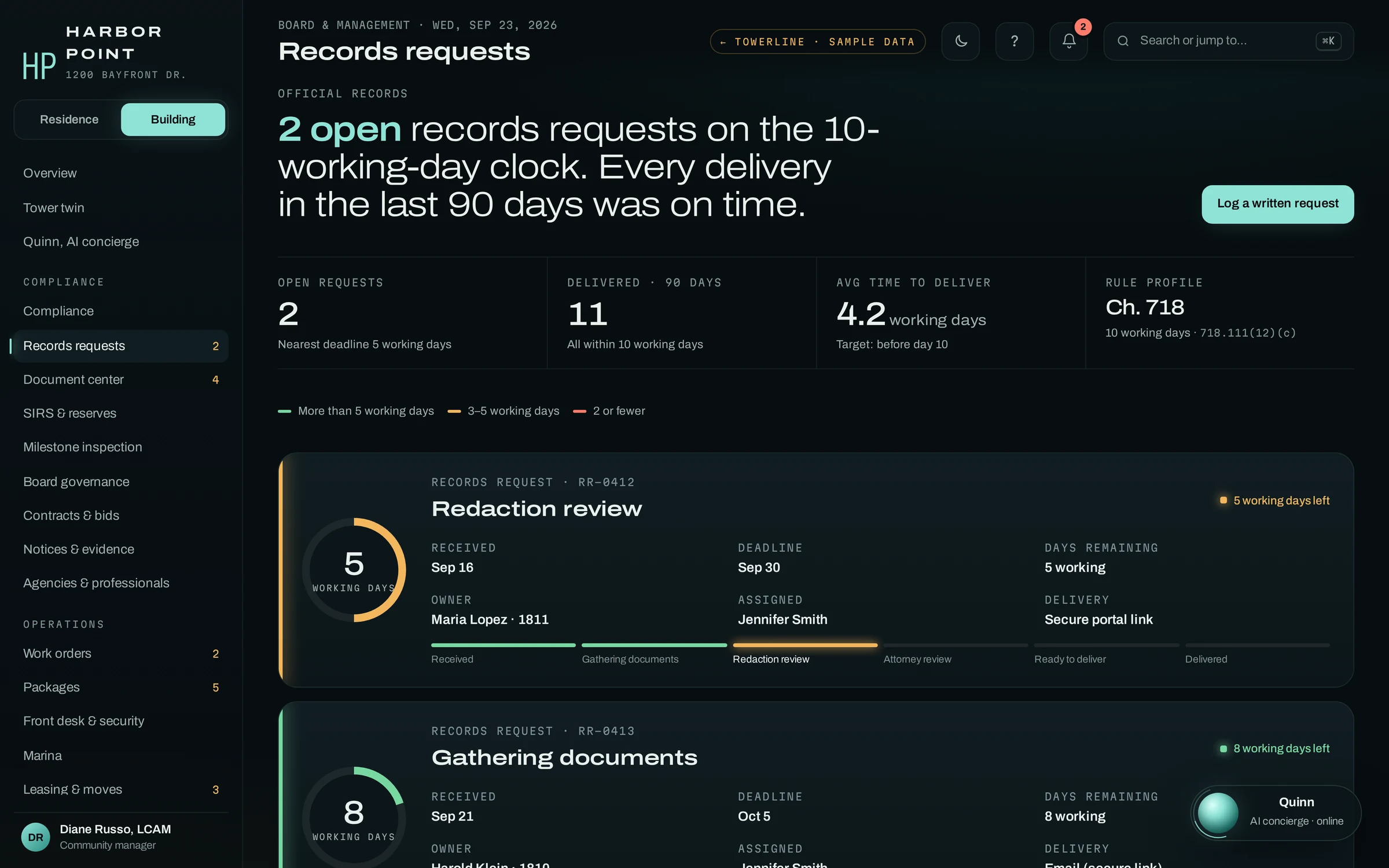
TowerLine AI's document center, in the Board Portal, is designed to keep an owner-only records area (which owners open in the Resident Portal) and a board-only folder, with a posting deadline on every document and a record of who published it and when. Owners and renters can get different access in the Resident Portal, and records requests can be logged with the date received and a working-day countdown. What to redact, and how the statute applies to your association, stays with your manager and counsel. The Florida Hub maps each requirement in this guide to the workflow that tracks it.
Frequently asked questions
When did the 25-unit rule take effect?
January 1, 2026. HB 1021, passed in 2024, lowered the threshold from 150 units to 25 with that effective date. The requirement is in section 718.111(12)(g), Florida Statutes, and covers associations managing a condominium with 25 or more units that contains no timeshare units. New records go up within 30 days of receipt or creation.
Can a condo association use an app instead of a website?
Yes. The statute allows the documents to be posted on a website or made available through an application that can be downloaded on a mobile device, as long as the records sit in a protected area open only to unit owners and association employees.
Do tenants get access to the protected section?
No. The statute describes the protected section as accessible only to unit owners and employees of the association. Renters have a narrower right of their own: under section 718.111(12)(c)1.a, a renter may inspect and copy only the declaration, the bylaws and rules, and the inspection reports described in sections 553.899 and 718.301(4)(p). Give renters those documents through resident access, and keep the rest in the owner-only area.
What happens if an association does not post a required document?
A failure to post does not by itself invalidate a board decision. It still sends owners to written records requests, and a willful failure to produce records within 10 working days carries minimum damages of $50 per calendar day for up to 10 days under section 718.111(12)(c). Owners can also complain to DBPR's Division of Florida Condominiums, Timeshares, and Mobile Homes, which enforces Chapter 718 on matters that include owner access to association records under section 718.501(1).
Sources
- Section 718.111, Florida Statutes (2026): official records, website requirements, inspection rights
- Section 718.112, Florida Statutes (2026): board meeting notice
- Section 718.501, Florida Statutes (2026): the Division's enforcement authority
- CS/CS/CS/HB 1021 (2024), Community Associations, ch. 2024-244
- HB 1021 final bill analysis
- CS/CS/HB 913 (2025), Condominium and Cooperative Associations, ch. 2025-175
- HB 913 final bill analysis
- DBPR condominium FAQs
- HB 657 (2026), Community Associations: bill history (died in Senate Rules)
- SB 104 (2026), ch. 2026-14: reviser's bill
- HB 797 (2026), ch. 2026-168: nonprofit corporations
This guide is general information, not legal advice. Coverage, redaction and retention questions turn on your declaration, your bylaws and the facts of your association, so confirm them with a Florida community association attorney before you rely on this summary.